The Real Reason the Pixel 12 Needs the Tensor G7: Google’s AI Ambitions Explained
Even though the Google Pixel 11 is still fresh on the market, the smartphone industry is already looking ahead to 2027. Recent supply chain leaks have begun to surface regarding the Google Pixel 12, but the most important detail isn't about screen size or camera megapixels—it is entirely about the silicon running the show.
Search interest for the Tensor G7 is skyrocketing, and for good reason. For Google to achieve its ultimate vision of a true AI-first smartphone, the current generation of mobile processors simply isn't enough. Here is a deep dive into the recent "LaJolla" codename leaks, why current flagships struggle with artificial intelligence, and how the move to a 2nm manufacturing process will fundamentally change how you use your phone.
The "LaJolla" Leak: A Glimpse into 2027
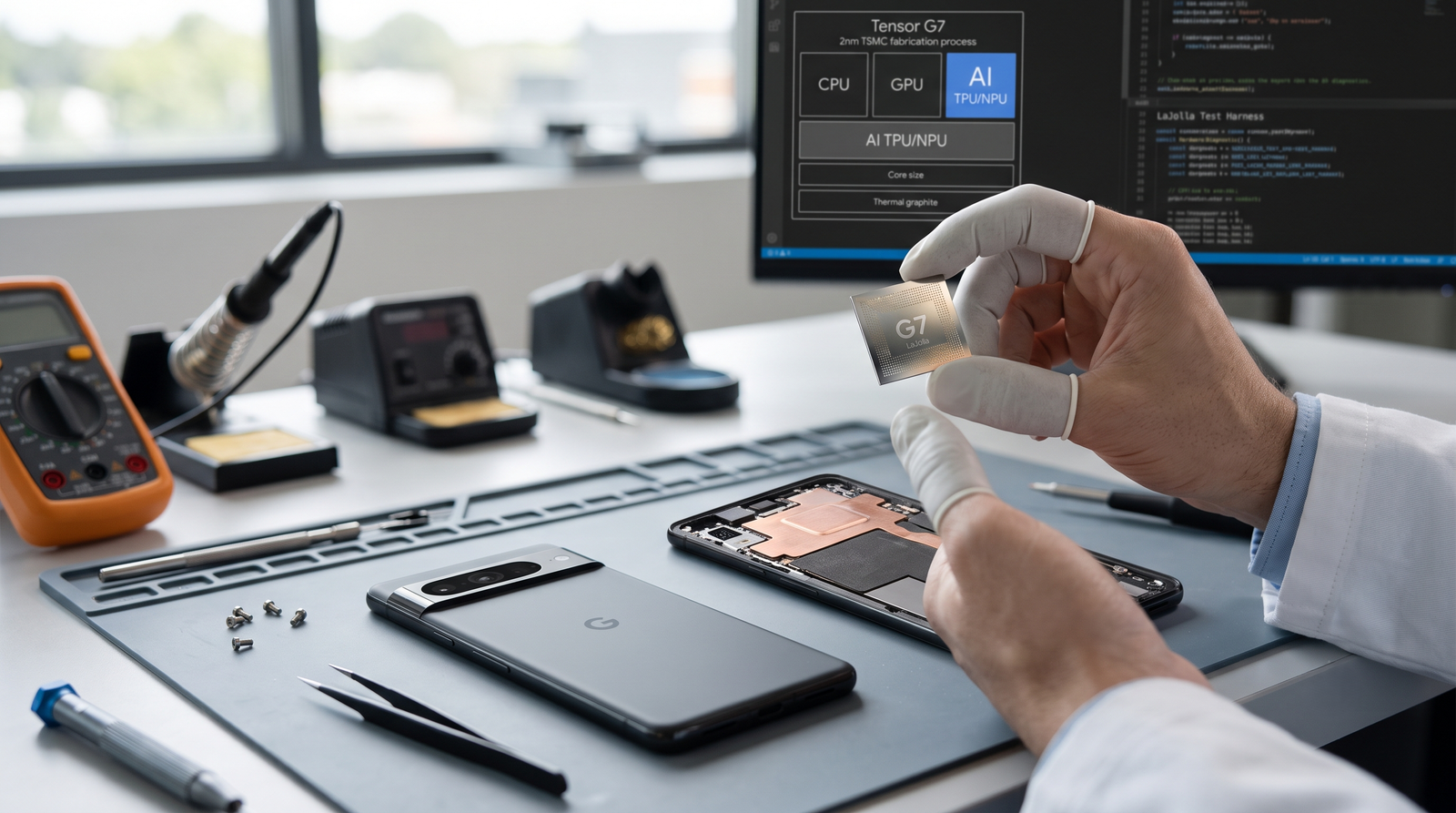
The rumor mill caught fire recently when early leaks from Telegram and the GSMA IMEI database revealed the internal codename for Google's 2027 chipset: "LaJolla". While a codename alone doesn't give us benchmark scores, supply chain reports indicate that the LaJolla chip—officially the Tensor G7—will be built using TSMC’s cutting-edge 2nm fabrication process.
To understand why this is a massive deal, we have to look at Google's hardware history. Early Tensor generations struggled with efficiency and connectivity. With the current Tensor G6, Google made significant strides by moving to TSMC's foundries and swapping out problematic modems. However, the Tensor G7 represents a "maturity milestone". Rather than just playing catch-up with Apple and Qualcomm on raw gaming benchmarks, Google is custom-designing the G7 specifically to handle heavy, sustained AI workloads.
The Thermal Reality: Why Current Chips Struggle with AI
To understand why the Tensor G7 is so necessary, you have to understand the physical toll that Artificial Intelligence takes on a smartphone.
Features like Magic Eraser, real-time voice transcription, and live translation are incredibly demanding. When you ask a modern smartphone to run a Large Language Model (LLM) like Gemini Nano entirely on the device (without relying on a cloud server), the processor is forced into overdrive. This creates a massive bottleneck: Heat.
When current mobile processors get too hot, they suffer from thermal throttling. The phone intentionally slows itself down to prevent internal damage. This is why if you try to use intense AI video processing or extended mobile gaming sessions on older devices, the phone gets uncomfortably hot, the battery drains rapidly, and the system begins to lag.
For Google to introduce the next wave of proactive AI—an assistant that constantly monitors your screen context, anticipates your needs, and runs complex tasks seamlessly in the background—they need a chip that can run at maximum capacity for extended periods without turning into a pocket heater.
Why the 2nm TSMC Process Changes Everything
This is exactly where the 2nm TSMC fabrication process comes into play for the Tensor G7.
In semiconductor manufacturing, "2nm" refers to the size of the transistors on the chip. The smaller the transistors, the more you can pack into the exact same physical space. But more importantly, smaller transistors require significantly less power to move electrical signals, which directly translates to less heat generation.
By moving the Tensor G7 to a 2nm node, Google unlocks several massive advantages for the Pixel 12:
- Sustained AI Performance: The Pixel 12 will be able to run complex Gemini AI models continuously without the phone overheating or aggressively throttling its speed.
- Massive Battery Gains: Because the 2nm chip is hyper-efficient, the device will draw significantly less power during everyday tasks. When combined with the rumored silicon-carbon batteries coming to the Pixel 12 lineup, we could finally see a multi-day battery life on a Pixel flagship.
- Advanced Image Signal Processing (ISP): The Tensor G7 is expected to feature a heavily upgraded ISP. This means that complex computational photography tasks—like rendering Night Sight photos or processing high-dynamic-range video—will happen almost instantaneously without draining your battery.
The Future of the Pixel Ecosystem
While competitors like the iPhone 18 Pro and Galaxy S26 Ultra will undoubtedly feature incredibly fast processors, Google is playing a different game. The Tensor G7 isn't about setting high scores on Geekbench; it is about creating an ambient, frictionless AI experience that just works, all day long.
The Pixel 12 and its LaJolla processor are still a long way off, with an expected release in late 2027. If you are looking to upgrade today, the current generation still offers incredible AI features. Be sure to check out the best phone deals in the USA to see how aggressive carrier trade-in offers are for the latest tech.
Stay tuned to the DevDuniya tech blogs as we continue to track the latest TSMC benchmarks and Google supply chain leaks!